This week in science we finished learning about rocks and minerals. We finished the contest on the minerals packet. We learned how to find the density of minerals and how to tell the differencs. We had to identify where they were on the hardness scale, cleavage, luster, and color streak. We leaned that sometimes the color streak isn't the same color as the outside color. Some problems that came up while we were doing the packet was we didn't know the exact harness scale so it was hard to place them in order. The measurments on how to find density weren't exact either so we didn't know if it was right.
Also this week we started to learn about physics. We learned about how sometimes you can bemoving and not know it so if you see something you pass, you could think it's moving and you are staying still. Famous scientists strated out with a geocentirc model instead of a heliocentric model because they thought the earth was still and all other planets moved. If they had known the earth moved they would have known that the planets revolve around the sun.
We also learned that if there are two cars and one is moving forwards and one stays still, the car that's moving could think the other car is going backwards. So if something is still, depending on the movement of something else, that something else could still think the stationary object is moving.
Saturday, February 28, 2009

Sunday, February 8, 2009
This week in science we classified cookies and chips. We learned about how there are different kinds of rocks in one whole rock. There are ingrediants on cookies that make a cookie so a rocks and cookies are alike.
We also learned about James Hutton. James Hutton came up with the theory of uniformitarianism. It is the theory that erosion and sedimentation have always been modifying the earth. It also says that erosion and sedimentation happen over a very long period of time. People didn't accept his theory because earthquakes and things like that happened very fast. They changed the earth very fast and his theory said it happens slowly.
We also learned about which rocks are harder then other rocks. Diamond is the hardest rock and Talc is the softest. We learned about the scale id hardness which is called the Mohs Scale. Talc is the softest the next are Gypsum, Calcite, Flourite, Apatite, Quartz, Corundum, and Diamond is the hardest. Talc Gypsum and Flourite can be scratched by a fingernail but the rest are to hard. Diamonds can scratch glass with little effort.
We also learned about James Hutton. James Hutton came up with the theory of uniformitarianism. It is the theory that erosion and sedimentation have always been modifying the earth. It also says that erosion and sedimentation happen over a very long period of time. People didn't accept his theory because earthquakes and things like that happened very fast. They changed the earth very fast and his theory said it happens slowly.
We also learned about which rocks are harder then other rocks. Diamond is the hardest rock and Talc is the softest. We learned about the scale id hardness which is called the Mohs Scale. Talc is the softest the next are Gypsum, Calcite, Flourite, Apatite, Quartz, Corundum, and Diamond is the hardest. Talc Gypsum and Flourite can be scratched by a fingernail but the rest are to hard. Diamonds can scratch glass with little effort.
Saturday, January 31, 2009
This week in science we each had to bring in a rock and classify it. The rock I had to classify was white and shiny. It looked like the shiny part was small crystals. The rock was heavy as it was once bigger and something compacted it and it got really small. I think the rock I had was a metamorphic rock. I think heat and pressure transformed an igneous rock into a metamorphic rock and thats the rock i had to classify.
I think this rock is metamorphic because it had a shiny coating. When I looked at it under the stereoscope the shiny coating looked like small crystals. Igneous rocks have crystals in them sometimes. When the heat and prssure started changing the igneous rock the crystals were crushed and formed a coating over the new rock. I think that the rock i was supposed to classify is a metamorphic rock but was once an igneous rock.
This week in science we also lesrned about heating. We learned that heat is not an actual physical thing. We also learned how a thermometer works. The particles in the thermometer start moving very fast when the air particles around the thermometer start colliding against them. When the particles in the thermometer move faster they need more room to move around so they start moving up.
I think this rock is metamorphic because it had a shiny coating. When I looked at it under the stereoscope the shiny coating looked like small crystals. Igneous rocks have crystals in them sometimes. When the heat and prssure started changing the igneous rock the crystals were crushed and formed a coating over the new rock. I think that the rock i was supposed to classify is a metamorphic rock but was once an igneous rock.
This week in science we also lesrned about heating. We learned that heat is not an actual physical thing. We also learned how a thermometer works. The particles in the thermometer start moving very fast when the air particles around the thermometer start colliding against them. When the particles in the thermometer move faster they need more room to move around so they start moving up.
Saturday, January 24, 2009
This week in science we learned how to tell which rocks were igneous, metamorphic, or sedimentary. Igneous rocks might have crystals, metamorphic rocks are sometimes smooth, and sedimentary rocks break eaily.
One question asked in class was, "Can one type of rock turn into another type of rock?" I think that one type of rock can turn into another. The other question asked was "What has to happen for this to occur?" I think for this to happen subduction needs to occur. If there is one small plate that has metamorphic and sedimentary rock on it and another bigger plate collides into it then the smaller plate will be forced under the bigger plate. When the smaller plates is forced under the bigger one then the small one will melt down into magma. When that plate is melted everything on that plate will melt to. So those metamorphic and sedimentary rocks will melt. When the bigger plate cracks, magma will come up through that crack. That magma is made up from the melted sedimentary and metamorphic rocks so when it goes through the crack, it will cool. When the magma cools, it will turn into igneous rock. That igneous rock was once seimentary and metamorphic rock.
Also metamorphic and igneous rock can turn into sedimentary rock. If there is a land formation made up of metamorphic rock or igneous rock then it can be eroded. When the formation is eroded then those tiny pieces of the formation will get into the rivers and the rivers will bring it to a deposition zone. When the tiny pieces of metamorphic and igneous rock get into the deposition zone they get stuck together and form a rock. The rock that was once metamorphic and igneous is now sedimentary rock.
On Friday we learned that sometimes we have to break open a rock to see what kind of rock it is. The outside of the rock might be normal and look like cement but if you break it open, it could have crystals forming. That means the rock is probably igneous but if someone just looked at the outside they might not have known that.
One question asked in class was, "Can one type of rock turn into another type of rock?" I think that one type of rock can turn into another. The other question asked was "What has to happen for this to occur?" I think for this to happen subduction needs to occur. If there is one small plate that has metamorphic and sedimentary rock on it and another bigger plate collides into it then the smaller plate will be forced under the bigger plate. When the smaller plates is forced under the bigger one then the small one will melt down into magma. When that plate is melted everything on that plate will melt to. So those metamorphic and sedimentary rocks will melt. When the bigger plate cracks, magma will come up through that crack. That magma is made up from the melted sedimentary and metamorphic rocks so when it goes through the crack, it will cool. When the magma cools, it will turn into igneous rock. That igneous rock was once seimentary and metamorphic rock.
Also metamorphic and igneous rock can turn into sedimentary rock. If there is a land formation made up of metamorphic rock or igneous rock then it can be eroded. When the formation is eroded then those tiny pieces of the formation will get into the rivers and the rivers will bring it to a deposition zone. When the tiny pieces of metamorphic and igneous rock get into the deposition zone they get stuck together and form a rock. The rock that was once metamorphic and igneous is now sedimentary rock.
On Friday we learned that sometimes we have to break open a rock to see what kind of rock it is. The outside of the rock might be normal and look like cement but if you break it open, it could have crystals forming. That means the rock is probably igneous but if someone just looked at the outside they might not have known that.
Monday, January 19, 2009
This week in science we learned about crystals. We melted moth balls in class and the let them cool under different cicumstances to see how big the crystals would form. We let one cool in a glass of ice water, one cool at room temperature, and one cool in a very hot temperature. The moth ball that we put in the cold temperature formed a crystal very quickly and the moth ball we put in the hot temperature formed a crystal very slowly.
When the crystals were done forming we looked at them and they were all different sizes. The crystal that formed in the hot temperature was very small. The crystal that formed in the cold temperature was large and the crystal formed in room temperature was inbetween the sizes of the other two crystals. We realized that the longer it takes for the crystals to cool, the larger the crystals will be. If the crstal takes a long time to cool then the crystal will be very small and thin.
We also realized that if magma takes a long time to cool then the crystals inside it will be bigger. If the magma takes a very short time to cool then the crystals will be smaller. The moth balls are just like the rock and magma because the crystals form the same way in both.
When the crystals were done forming we looked at them and they were all different sizes. The crystal that formed in the hot temperature was very small. The crystal that formed in the cold temperature was large and the crystal formed in room temperature was inbetween the sizes of the other two crystals. We realized that the longer it takes for the crystals to cool, the larger the crystals will be. If the crstal takes a long time to cool then the crystal will be very small and thin.
We also realized that if magma takes a long time to cool then the crystals inside it will be bigger. If the magma takes a very short time to cool then the crystals will be smaller. The moth balls are just like the rock and magma because the crystals form the same way in both.
Sunday, January 11, 2009
This week in scienc we learned about what was happening in Iceland. Iceland is splitting apart bvecause the North Atalntic Ridge goes right though the middle of it. The North Atlantic Ridge is slowly breaking apart and that means Iceland is breaking into two peices.


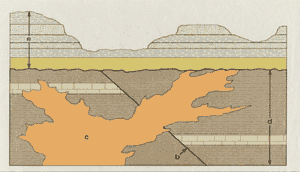

On Thursday we got a worksheet called "Determining the Age od Sedimentry Rock Layer". It had different laws on the front page. The laws were; Law of Superposition, Law of Original Horizontality, Law of Lateral Continuity, and Cross-Cutting Relationship.
Law of Superposition- This is when younger rock layers cover the older rock layers.
Law of Original Horizontality- This is when the rock layers cover each other horizontally.

Law of Lateral Continuity- Rock was deposited and then it seperated. Then the rck was alternated.
Cross-Cutting Relationship- A younger rock cuts through an older rock.
Sunday, December 21, 2008
This week during science we watched a movie about how the earth was created. The movie talked about how the earth was created by two planets crashing into each other. When they crashed there was so much force that the inside of the new planet melted and turned to magma ans lava. So now when never there plates shift and cracks appear, magma comes through and seals the cracks until they drift agan. When this happens over and over again, new land is created. When one plate gets stuck under another plate, the one underneath melts into magma. That way land is always being created and land is always being melted back down. With this system there will never be to much land or to little. We also learned about the layers in the earth. There is the crust, mantle, outer core, and inner core.The inner core is the hottest place and the crust is the coolest place. When two plates drift apart the magma comes from the inner core and surges upward toward the crust and fills in the place where the plates drifted apart.
We also learned about how the continents drfted apart. At the begining when there was one big super continent the Sahara Desert was ten times bigger then the one in America now. Mountains were at the ede of the continent and clouds got stuck on the ocean side. On the inside of the continent the water dried up and because there were no clouds, it couldn't rain. It got really dry and a desert formed. When the continent drifted apart the desert broke up. That's why there are a lot of the same fossils on different continents.
We also learned about how the continents drfted apart. At the begining when there was one big super continent the Sahara Desert was ten times bigger then the one in America now. Mountains were at the ede of the continent and clouds got stuck on the ocean side. On the inside of the continent the water dried up and because there were no clouds, it couldn't rain. It got really dry and a desert formed. When the continent drifted apart the desert broke up. That's why there are a lot of the same fossils on different continents.
Subscribe to:
Posts (Atom)