This week in science we continued using the bunsen burners. We did an experiment with heating wood in the test tube. The experiment was set up so that there were two test tubes connected with an elbow joint. There was a second elbow joint coming out of the the test tube and one of the test tubes was in a cup of water. The other test tube had wooden splints in it. That test tube was being held by the arm of the long pole coming out of a base. The bunsen burner was under that test tube. When the bunsen burner was lit, the wood started turning darker and darker until it was black. There was a lot of smoke looking gas coming off the wood. The gas went through the elbow joints, some going into the other test tube and some going into the air. Condensation began forming again the sides of the test tube turned black like in the sugar experiment last week.
In both experiments the objects broke down. They both got darker and turned black eventually. They both got condensation to form on the sides. Both gave off a smell but there were some differences. The sugar melted but the wood didn't.
Friday, June 12, 2009

Sunday, June 7, 2009
This week in science we used bunsen burners. The experiment we performed was to fill a test tube with sugar and place it over the bunsen burner. When we turned the bunsen burner on, eventually the sugar began melting. At first the sugar turned yellow and then it started getting to be brown. The sugar began turning into a liquid.The liquid's bubbles rose to the top of the test tube and smoke began coming off of it. The smoke caused condensation and rose into the air where we couldn't see it. Eventually the sugar turned black and hard. We broke open the test tube to observe the sugar closely. We learned that the sugar was broken down into it's elements.
Friday, May 29, 2009
This week in science we began learning the basics of chemistry. We learned that everything is made up of extremely small things called atoms. Theses atoms are made up of protons, electrons, and neutrons. They can be charged positively, negatively, or neutrally. When a balloon is rubbed on someones head their hair stands up. This is because the hair lost its protons and "wants to get the back" from the balloon. The hair goes toward the balloon because there are some protons still in the air and eventually all of them will come nack from the balloon. When the protons return to the hair, the hair will stop standing up and go back to normal.
We also learned about elements. Elements are classifications of the number of atoms in a group of them. Elements have a certain number of atoms so when the number of atoms changes, the element changes too. The atoms like to have a balanced number of electron and protons. When an atom cloud doesn't have an even number of something, it will do anything to balance itself out. The atoms will combine with other atoms electrons or protons. When atoms combine it becomes a differrent element because the number of atoms have changed.
We also learned about elements. Elements are classifications of the number of atoms in a group of them. Elements have a certain number of atoms so when the number of atoms changes, the element changes too. The atoms like to have a balanced number of electron and protons. When an atom cloud doesn't have an even number of something, it will do anything to balance itself out. The atoms will combine with other atoms electrons or protons. When atoms combine it becomes a differrent element because the number of atoms have changed.
Friday, May 22, 2009
This week in science we started learning about the phases of the moon. We learned that the first phase of the moon is New Moon. The next stages is are Cresant Moon, Half Moon, Gibbous Moon, and Full Moon. Then they go backwards and after that they repeat. When the moon seems to get bigger it is actually only getting more illuminated which gives the illusion of getting bigger. This is called waxing. When the same thing happens but instead of the moon gets bigger, it gets smaller, it is called Waning.Equinox is when the sun is at a direct point above the eqauter. When we have equinoxs the night is the same amount of time as the day.
We learned about tides. Neap Tides are when the Moon and Sun are at right angles. The forces cancel each other out partially. Then there are tides but there isn't much of a difference between high tide and low tide. We also learned about Spring Tides. Spring Tides are when the moon and sun are lined up with the earth and their forces combine. The water is pulled toward them. There is a big difference between high and low tide. A neumonic device to remeber sping tides is "the water seems to spring off the earth".
We learned about tides. Neap Tides are when the Moon and Sun are at right angles. The forces cancel each other out partially. Then there are tides but there isn't much of a difference between high tide and low tide. We also learned about Spring Tides. Spring Tides are when the moon and sun are lined up with the earth and their forces combine. The water is pulled toward them. There is a big difference between high and low tide. A neumonic device to remeber sping tides is "the water seems to spring off the earth".
Friday, May 15, 2009
This week in science we learned more about how the Earth's gravitational pull affects the Moon. We did an experiment to see what would happen if the Earth suddenly disappeared. We did the by getting a board of would that had a large circular hole vut out of it and an attachable part on the outside of it that could be removed. We set a ball in motion in the ring and when it came around by the attachable part someone took out the attachable part and the ball went out of the ring in a straight line. This means if the Earth ever disappeared the gravitational pull would be gone and the moon would travel in a straight line. Another way the moon could ever get out of the Earth's gravitational pull is if somehow it started going extremely fast. If an object goes fast enough it can "escape" another objects orbit. This is called Escape Velocity.
This week we also worked on porjects and presentations on experiments we did with coffee filters. The experimnet my group and I did was to change the form of the coffee filter. We thought if the form changed the speed would change. We fiegured out that the crumpled coffee filter fell the fastest. This supported out hypothesis.
This week we also worked on porjects and presentations on experiments we did with coffee filters. The experimnet my group and I did was to change the form of the coffee filter. We thought if the form changed the speed would change. We fiegured out that the crumpled coffee filter fell the fastest. This supported out hypothesis.
Friday, May 8, 2009
This week in science we learned that the more mass an object has, the more of a pull the earth has on it. We proved it by doing an experiment where one student held a bowling ball in one hand and a basketball in the other. He had a harder time holding the bowling ball in his hand. The basketball and bowling ball were about the same size but the bowling ball weighs more. That means the earth pulls more on the bowling ball but not on the basketball because it has less mass. We also learned force divided by mass equals exceleration.
This week in science we also learned that even though abjects have different masses, they will still land at the same time if you drop them at the same time. People often make the mistake of thinking the heavier object will land first but that's not true. The earth has a greater pull on the heavier object but that's only because it has more mass. The earth excerts the same amount of force on an object as the object does on the earth. It doesn't matter how much mass an abject has because the earth will match it. This is why the two objects will fall and land at the same time when dropped at the same time.
This week in science we also learned that even though abjects have different masses, they will still land at the same time if you drop them at the same time. People often make the mistake of thinking the heavier object will land first but that's not true. The earth has a greater pull on the heavier object but that's only because it has more mass. The earth excerts the same amount of force on an object as the object does on the earth. It doesn't matter how much mass an abject has because the earth will match it. This is why the two objects will fall and land at the same time when dropped at the same time.
Friday, April 24, 2009
This week in science we prepared for the NJ ASK test. On Monday and Tuesday we saw a presentation on space and planets in our solar system. We learned the Sun is massive compared to the plantes like Pluto and our planet, Earth. The Sun is not massive, however, to the rest of the universe and the rest of space. Space goes on for millions and millions of light years.
On Wednesday we started learning about forces again. Two students from our class demonstrated an experiment for us.They both sat on carts and one held a bowling ball in his hands and threw it. The other student caught it and moved backward when he caught it. He threw it back to the first student and when he caught it, he moved backward. We learned that the student who threw the bowling ball excerted a force on it and the bowling ball excerted a force on the second student moving him backwards.
We also learned this week that of you hook two spring scales and two people pull on them with the same amount of force, they should read the same amount of Newtons. Some people might think they would both read 0 Newtons because they cancel each other out but forces can't eliminate another force even of it's the same amount.
On Wednesday we started learning about forces again. Two students from our class demonstrated an experiment for us.They both sat on carts and one held a bowling ball in his hands and threw it. The other student caught it and moved backward when he caught it. He threw it back to the first student and when he caught it, he moved backward. We learned that the student who threw the bowling ball excerted a force on it and the bowling ball excerted a force on the second student moving him backwards.
We also learned this week that of you hook two spring scales and two people pull on them with the same amount of force, they should read the same amount of Newtons. Some people might think they would both read 0 Newtons because they cancel each other out but forces can't eliminate another force even of it's the same amount.
Thursday, April 9, 2009
This week in science we continued with the dynamic lesson we have been doing. We finished lesson five and lesson seven. In lesson five there was a question that involved the motion of a hockey puck. In the question we had to come up with a story where there was the hockey puck was moving but then an unbalanced force comes. The hockey puck keeps moving though. My story was a player was pushing the puck with their stick and another player started pushing on the puck with their stick in the opposite direction. This story means that even though there are two forces on an object it can still move just at a different velocity.
In lesson seven the questions involved two students, one on roller blades and the other pushed the student down a hallway. The first graph showed a flat. the Y axis was the velocity and the X axis was the time. The flat line meant the student on roller blades was going at the same speed the whole time after the other student pushed her. The first graph had the position on the Y axis and the time on the X axis. In the beginning of the graph there was a line but later in the graph it had a line below it from where it ended. This meant the student was moving forward but then she turned around and went backwards. whenever there are two lines and the second one is behind and below the first that means whatever object it is representing moved backwards.
In lesson seven the questions involved two students, one on roller blades and the other pushed the student down a hallway. The first graph showed a flat. the Y axis was the velocity and the X axis was the time. The flat line meant the student on roller blades was going at the same speed the whole time after the other student pushed her. The first graph had the position on the Y axis and the time on the X axis. In the beginning of the graph there was a line but later in the graph it had a line below it from where it ended. This meant the student was moving forward but then she turned around and went backwards. whenever there are two lines and the second one is behind and below the first that means whatever object it is representing moved backwards.
Friday, April 3, 2009
This week in science we started learning about forces of motion and dynamics. We started by learning how to make a force diagram. To make a force diagram you have to draw a dot to represent the object and then one arrow coming out of the dot and pointing up. Then you have to make one coming down and pointing down. Label the down arrow Force of the Earth on (object). Then label the up arrow the Force of (other source exerting force)on (object). Sometimes there is more then arrrow because sometimes there only the earth is exerting force on the object. Sometimes there are more arrows because there are multiple forces.
We also observed the difference of holding a basketball and a bowling ball. To hold up the bowling ball we have to push up more then we have to when we hold the basketball. It is harder to hold up the bowling ball because it exerts a bigger force on out hands.
We also learned what units we use to tell how great the force is. These are call Newtons. Then we learned how to use them in a number sentence. If I was holding the bowling ball then it might be exerting 10N (Newtons) on my hand and the earth would also be exerting 10N. Then number sentence would be 10N+(-10n)=0N.
We also observed the difference of holding a basketball and a bowling ball. To hold up the bowling ball we have to push up more then we have to when we hold the basketball. It is harder to hold up the bowling ball because it exerts a bigger force on out hands.
We also learned what units we use to tell how great the force is. These are call Newtons. Then we learned how to use them in a number sentence. If I was holding the bowling ball then it might be exerting 10N (Newtons) on my hand and the earth would also be exerting 10N. Then number sentence would be 10N+(-10n)=0N.
Sunday, March 29, 2009
This week in science we continued with kinematics. In lesson 12.2 there is a graph showing the motion of a car. In part of the graph there was a flat line and the position and the time were showed on the sides. It said the position of the car was staying the same but the time was getting longer. I learned that if there is ever a flat line, that means whatever the graph is representing has stopped. In the next graph the line is going up and then going down. From this graph I learned that the whatever the graph is representing has sped up and then slowed down.
In lesson 11.7 there was a question that asked how long a line would be if 10 billion people lined up shoulder to shoulder. Then there was another question that asked if the earth could be considered a particle compared to this line. I think the earth could be considered a partical if everyone lined up because the line would be a lot longer then the earth is wide. Then the next question was about how pecise them measurements are. What I learned from these questions is that the calculations will always be a little bit off because you can't get the exact measurement of something.
In lesson 11.7 there was a question that asked how long a line would be if 10 billion people lined up shoulder to shoulder. Then there was another question that asked if the earth could be considered a particle compared to this line. I think the earth could be considered a partical if everyone lined up because the line would be a lot longer then the earth is wide. Then the next question was about how pecise them measurements are. What I learned from these questions is that the calculations will always be a little bit off because you can't get the exact measurement of something.
Friday, March 13, 2009
This week in science we did a series of worksheets. The worksheets helped us learn about the motion of objects. We learned that a trend line is a line on a graoh that represents the average of two sets of datda. On the worksheet 7.1 we had to find the rate that a slow car traveled and the rate a fast car traveled. Then we had out if the two speeds were consant. We got a slow car and measured out a meter. Someone from out group was the time keeper and said when every second passed while someone else made a mark at the front of the car where it was at the second. We did the same thing with a fast car. At the end of the test we mearued between the marks. We looked at the slow car first. The marks were differrent distances apart but were relatively close together. The marks were within 5 centimeters apart so the car didn't move at an exact rate but it moved at an almost constant rate.
When we looked at the results we also realized that the slow car went faster in the first second then the fast car. The second second the same thing happened but then in the third second the fast car sped up and went faster then then slow car.
When we looked at the results we also realized that the slow car went faster in the first second then the fast car. The second second the same thing happened but then in the third second the fast car sped up and went faster then then slow car.
Friday, March 6, 2009
This week in science we did an experiment with toy cars to see if they stayed at a constant speed or if they sped up or slowed down. We marked off every 10 centimeters on the floor and started the car off at a starting line near the begining of the marks. Someone acted as a metronome and told the other people in the group when every second passed. We started the car and when a second passed someone marked off where the car was. When the car went far enough we stopped it and looked at the marks on the floor. The marks were different distances apart but generally the same. We came to the conclusion that the car was moving at a constant rate. It didn't speed up or slow down.
Saturday, February 28, 2009
This week in science we finished learning about rocks and minerals. We finished the contest on the minerals packet. We learned how to find the density of minerals and how to tell the differencs. We had to identify where they were on the hardness scale, cleavage, luster, and color streak. We leaned that sometimes the color streak isn't the same color as the outside color. Some problems that came up while we were doing the packet was we didn't know the exact harness scale so it was hard to place them in order. The measurments on how to find density weren't exact either so we didn't know if it was right.
Also this week we started to learn about physics. We learned about how sometimes you can bemoving and not know it so if you see something you pass, you could think it's moving and you are staying still. Famous scientists strated out with a geocentirc model instead of a heliocentric model because they thought the earth was still and all other planets moved. If they had known the earth moved they would have known that the planets revolve around the sun.
We also learned that if there are two cars and one is moving forwards and one stays still, the car that's moving could think the other car is going backwards. So if something is still, depending on the movement of something else, that something else could still think the stationary object is moving.
Also this week we started to learn about physics. We learned about how sometimes you can bemoving and not know it so if you see something you pass, you could think it's moving and you are staying still. Famous scientists strated out with a geocentirc model instead of a heliocentric model because they thought the earth was still and all other planets moved. If they had known the earth moved they would have known that the planets revolve around the sun.
We also learned that if there are two cars and one is moving forwards and one stays still, the car that's moving could think the other car is going backwards. So if something is still, depending on the movement of something else, that something else could still think the stationary object is moving.
Sunday, February 8, 2009
This week in science we classified cookies and chips. We learned about how there are different kinds of rocks in one whole rock. There are ingrediants on cookies that make a cookie so a rocks and cookies are alike.
We also learned about James Hutton. James Hutton came up with the theory of uniformitarianism. It is the theory that erosion and sedimentation have always been modifying the earth. It also says that erosion and sedimentation happen over a very long period of time. People didn't accept his theory because earthquakes and things like that happened very fast. They changed the earth very fast and his theory said it happens slowly.
We also learned about which rocks are harder then other rocks. Diamond is the hardest rock and Talc is the softest. We learned about the scale id hardness which is called the Mohs Scale. Talc is the softest the next are Gypsum, Calcite, Flourite, Apatite, Quartz, Corundum, and Diamond is the hardest. Talc Gypsum and Flourite can be scratched by a fingernail but the rest are to hard. Diamonds can scratch glass with little effort.
We also learned about James Hutton. James Hutton came up with the theory of uniformitarianism. It is the theory that erosion and sedimentation have always been modifying the earth. It also says that erosion and sedimentation happen over a very long period of time. People didn't accept his theory because earthquakes and things like that happened very fast. They changed the earth very fast and his theory said it happens slowly.
We also learned about which rocks are harder then other rocks. Diamond is the hardest rock and Talc is the softest. We learned about the scale id hardness which is called the Mohs Scale. Talc is the softest the next are Gypsum, Calcite, Flourite, Apatite, Quartz, Corundum, and Diamond is the hardest. Talc Gypsum and Flourite can be scratched by a fingernail but the rest are to hard. Diamonds can scratch glass with little effort.
Saturday, January 31, 2009
This week in science we each had to bring in a rock and classify it. The rock I had to classify was white and shiny. It looked like the shiny part was small crystals. The rock was heavy as it was once bigger and something compacted it and it got really small. I think the rock I had was a metamorphic rock. I think heat and pressure transformed an igneous rock into a metamorphic rock and thats the rock i had to classify.
I think this rock is metamorphic because it had a shiny coating. When I looked at it under the stereoscope the shiny coating looked like small crystals. Igneous rocks have crystals in them sometimes. When the heat and prssure started changing the igneous rock the crystals were crushed and formed a coating over the new rock. I think that the rock i was supposed to classify is a metamorphic rock but was once an igneous rock.
This week in science we also lesrned about heating. We learned that heat is not an actual physical thing. We also learned how a thermometer works. The particles in the thermometer start moving very fast when the air particles around the thermometer start colliding against them. When the particles in the thermometer move faster they need more room to move around so they start moving up.
I think this rock is metamorphic because it had a shiny coating. When I looked at it under the stereoscope the shiny coating looked like small crystals. Igneous rocks have crystals in them sometimes. When the heat and prssure started changing the igneous rock the crystals were crushed and formed a coating over the new rock. I think that the rock i was supposed to classify is a metamorphic rock but was once an igneous rock.
This week in science we also lesrned about heating. We learned that heat is not an actual physical thing. We also learned how a thermometer works. The particles in the thermometer start moving very fast when the air particles around the thermometer start colliding against them. When the particles in the thermometer move faster they need more room to move around so they start moving up.
Saturday, January 24, 2009
This week in science we learned how to tell which rocks were igneous, metamorphic, or sedimentary. Igneous rocks might have crystals, metamorphic rocks are sometimes smooth, and sedimentary rocks break eaily.
One question asked in class was, "Can one type of rock turn into another type of rock?" I think that one type of rock can turn into another. The other question asked was "What has to happen for this to occur?" I think for this to happen subduction needs to occur. If there is one small plate that has metamorphic and sedimentary rock on it and another bigger plate collides into it then the smaller plate will be forced under the bigger plate. When the smaller plates is forced under the bigger one then the small one will melt down into magma. When that plate is melted everything on that plate will melt to. So those metamorphic and sedimentary rocks will melt. When the bigger plate cracks, magma will come up through that crack. That magma is made up from the melted sedimentary and metamorphic rocks so when it goes through the crack, it will cool. When the magma cools, it will turn into igneous rock. That igneous rock was once seimentary and metamorphic rock.
Also metamorphic and igneous rock can turn into sedimentary rock. If there is a land formation made up of metamorphic rock or igneous rock then it can be eroded. When the formation is eroded then those tiny pieces of the formation will get into the rivers and the rivers will bring it to a deposition zone. When the tiny pieces of metamorphic and igneous rock get into the deposition zone they get stuck together and form a rock. The rock that was once metamorphic and igneous is now sedimentary rock.
On Friday we learned that sometimes we have to break open a rock to see what kind of rock it is. The outside of the rock might be normal and look like cement but if you break it open, it could have crystals forming. That means the rock is probably igneous but if someone just looked at the outside they might not have known that.
One question asked in class was, "Can one type of rock turn into another type of rock?" I think that one type of rock can turn into another. The other question asked was "What has to happen for this to occur?" I think for this to happen subduction needs to occur. If there is one small plate that has metamorphic and sedimentary rock on it and another bigger plate collides into it then the smaller plate will be forced under the bigger plate. When the smaller plates is forced under the bigger one then the small one will melt down into magma. When that plate is melted everything on that plate will melt to. So those metamorphic and sedimentary rocks will melt. When the bigger plate cracks, magma will come up through that crack. That magma is made up from the melted sedimentary and metamorphic rocks so when it goes through the crack, it will cool. When the magma cools, it will turn into igneous rock. That igneous rock was once seimentary and metamorphic rock.
Also metamorphic and igneous rock can turn into sedimentary rock. If there is a land formation made up of metamorphic rock or igneous rock then it can be eroded. When the formation is eroded then those tiny pieces of the formation will get into the rivers and the rivers will bring it to a deposition zone. When the tiny pieces of metamorphic and igneous rock get into the deposition zone they get stuck together and form a rock. The rock that was once metamorphic and igneous is now sedimentary rock.
On Friday we learned that sometimes we have to break open a rock to see what kind of rock it is. The outside of the rock might be normal and look like cement but if you break it open, it could have crystals forming. That means the rock is probably igneous but if someone just looked at the outside they might not have known that.
Monday, January 19, 2009
This week in science we learned about crystals. We melted moth balls in class and the let them cool under different cicumstances to see how big the crystals would form. We let one cool in a glass of ice water, one cool at room temperature, and one cool in a very hot temperature. The moth ball that we put in the cold temperature formed a crystal very quickly and the moth ball we put in the hot temperature formed a crystal very slowly.
When the crystals were done forming we looked at them and they were all different sizes. The crystal that formed in the hot temperature was very small. The crystal that formed in the cold temperature was large and the crystal formed in room temperature was inbetween the sizes of the other two crystals. We realized that the longer it takes for the crystals to cool, the larger the crystals will be. If the crstal takes a long time to cool then the crystal will be very small and thin.
We also realized that if magma takes a long time to cool then the crystals inside it will be bigger. If the magma takes a very short time to cool then the crystals will be smaller. The moth balls are just like the rock and magma because the crystals form the same way in both.
When the crystals were done forming we looked at them and they were all different sizes. The crystal that formed in the hot temperature was very small. The crystal that formed in the cold temperature was large and the crystal formed in room temperature was inbetween the sizes of the other two crystals. We realized that the longer it takes for the crystals to cool, the larger the crystals will be. If the crstal takes a long time to cool then the crystal will be very small and thin.
We also realized that if magma takes a long time to cool then the crystals inside it will be bigger. If the magma takes a very short time to cool then the crystals will be smaller. The moth balls are just like the rock and magma because the crystals form the same way in both.
Sunday, January 11, 2009
This week in scienc we learned about what was happening in Iceland. Iceland is splitting apart bvecause the North Atalntic Ridge goes right though the middle of it. The North Atlantic Ridge is slowly breaking apart and that means Iceland is breaking into two peices.


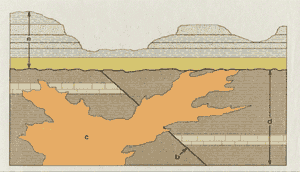

On Thursday we got a worksheet called "Determining the Age od Sedimentry Rock Layer". It had different laws on the front page. The laws were; Law of Superposition, Law of Original Horizontality, Law of Lateral Continuity, and Cross-Cutting Relationship.
Law of Superposition- This is when younger rock layers cover the older rock layers.
Law of Original Horizontality- This is when the rock layers cover each other horizontally.

Law of Lateral Continuity- Rock was deposited and then it seperated. Then the rck was alternated.
Cross-Cutting Relationship- A younger rock cuts through an older rock.
Sunday, December 21, 2008
This week during science we watched a movie about how the earth was created. The movie talked about how the earth was created by two planets crashing into each other. When they crashed there was so much force that the inside of the new planet melted and turned to magma ans lava. So now when never there plates shift and cracks appear, magma comes through and seals the cracks until they drift agan. When this happens over and over again, new land is created. When one plate gets stuck under another plate, the one underneath melts into magma. That way land is always being created and land is always being melted back down. With this system there will never be to much land or to little. We also learned about the layers in the earth. There is the crust, mantle, outer core, and inner core.The inner core is the hottest place and the crust is the coolest place. When two plates drift apart the magma comes from the inner core and surges upward toward the crust and fills in the place where the plates drifted apart.
We also learned about how the continents drfted apart. At the begining when there was one big super continent the Sahara Desert was ten times bigger then the one in America now. Mountains were at the ede of the continent and clouds got stuck on the ocean side. On the inside of the continent the water dried up and because there were no clouds, it couldn't rain. It got really dry and a desert formed. When the continent drifted apart the desert broke up. That's why there are a lot of the same fossils on different continents.
We also learned about how the continents drfted apart. At the begining when there was one big super continent the Sahara Desert was ten times bigger then the one in America now. Mountains were at the ede of the continent and clouds got stuck on the ocean side. On the inside of the continent the water dried up and because there were no clouds, it couldn't rain. It got really dry and a desert formed. When the continent drifted apart the desert broke up. That's why there are a lot of the same fossils on different continents.
Monday, December 15, 2008
We observed rocks under a microscope. We had to figure out if they were ignius, sedimentry, or metamorphic. I think the rocks were sedimentry because sedimentry rocks are rocks that are mixed with sand and other small rocks. Sedimentry rocks are the "left over" from the mountains. These rocks had sand mixed in with them and because of their location they might have come from the mountains. The Appalachain Mountain chain is close by here and if the rocks from the mountains got into the water system near the mountains then the rivers there could have branched off into the Passaic River. That's how we found them.
I think the rocks we found are also ignious rocks because when two plates are pushed together they form a mountain range. When two plates have a collision like that there is so much force that some of the rock gets melted and turns into magma and hardens into ignius rocks. I think that the Appalachian Mountain Range was a result of two plates colliding and when they did, they formed magama and the rivers near there brought that ignius rocks to the Passaic River.
draft
I think the rocks we found are also ignious rocks because when two plates are pushed together they form a mountain range. When two plates have a collision like that there is so much force that some of the rock gets melted and turns into magma and hardens into ignius rocks. I think that the Appalachian Mountain Range was a result of two plates colliding and when they did, they formed magama and the rivers near there brought that ignius rocks to the Passaic River.
draft
Subscribe to:
Posts (Atom)